

1601 Haight Street · Haight & Clayton
A Corner That
Never Stands Still
One Hundred and Thirty Years of History at Haight and Clayton — From the Shoot the Chutes Amusement Park to Achilles Heel, Hobson’s Choice, and The Green Heron
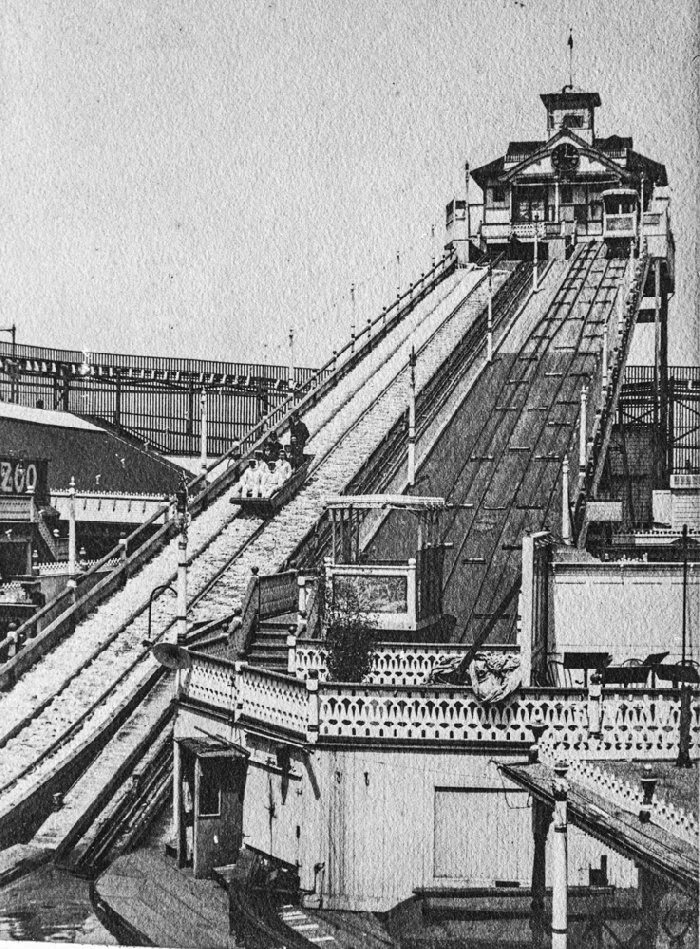
Looking down the Haight Street Chutes on Opening Day, November 2, 1895 · wnp26.1135 / OpenSFHistory
There are corners in a city that seem constitutionally incapable of standing still. Not every block generates life the way this one does — but the corner of Haight Street and Clayton Street in San Francisco’s Upper Haight-Ashbury has been drawing crowds since the administration of Grover Cleveland. A 70-foot water chute tower once rose from this spot. A lion named Wallace paced in a zoo here. Boats hit the man-made lake at up to sixty miles an hour, the front ends shooting skyward on impact, sometimes flipping entirely. This was considered part of the fun.
That was 1895. In the 130 years since, this corner has hosted a pharmacy, a tool shop, a hairstylist’s, a barber named Delaney, a controversial straight bar in a neighborhood fiercely negotiating its own identity, a beloved rum punch house that lasted 26 years, and now the Green Heron. Each incarnation wrote itself into these walls. This is the full story.
1895 — 1902
Part OneThe Haight Street Chutes
The Land: John Baird and the Powder Works
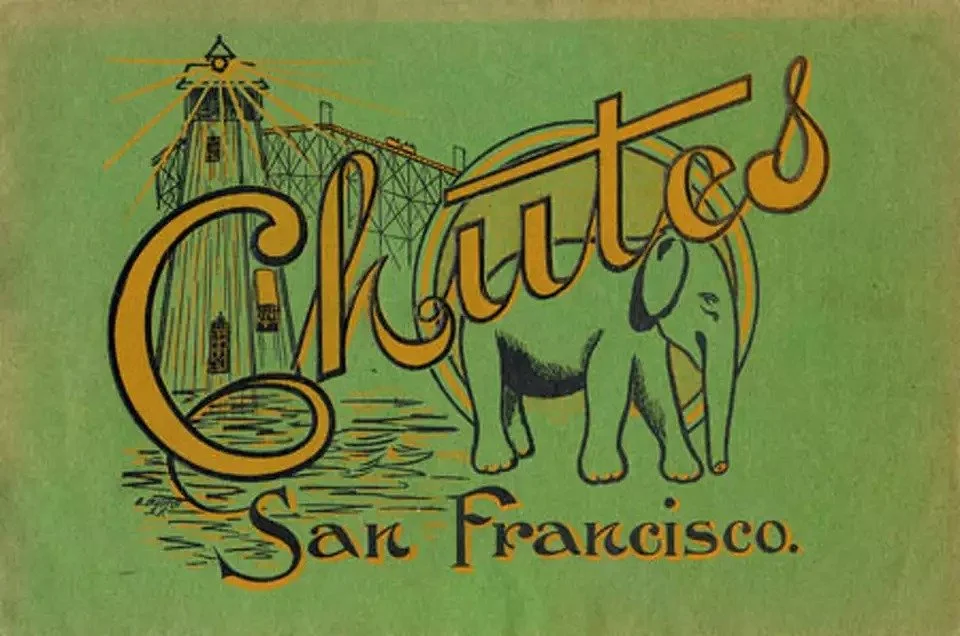
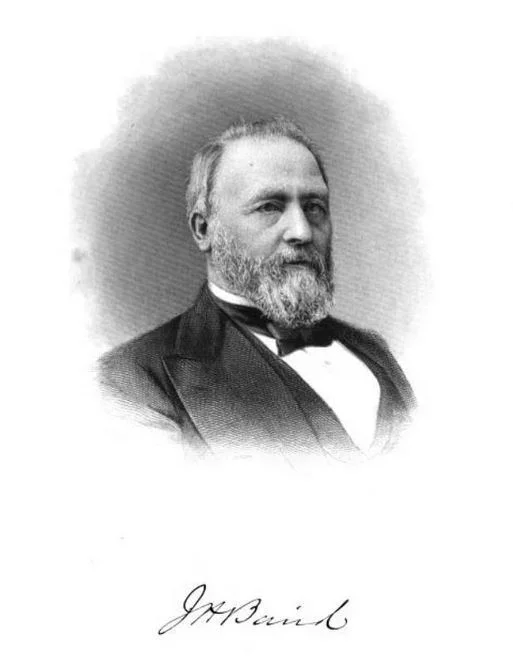
Before any ride was built here, this block had a history that shaped everything that followed. The land bounded by Haight, Cole, Waller, and Clayton Streets was owned by the estate of John H. Baird, president of the California Powder Works — the sole manufacturer of black powder in California, supplying blasting powder to miners and railroad workers throughout the region. The original plant was founded in the San Lorenzo Valley in 1861; a second location opened in the Inner Sunset near 2nd Avenue and Irving Street in 1869, then moved to what became Hercules, California — a town that took its name from the “Hercules Powder” manufactured there. Baird died in 1880, leaving an estate ultimately valued at $1,000,000 (over $287 million today). Under the terms of the trust, the estate could not be distributed until his youngest child turned 21. As Hoodline’s 2016 history documents, that constraint would determine the Chutes’ entire lifespan.
The Ride: Paul Boyton and the Nonexclusive License
The concept of the water chute was invented by Paul Boyton, an adventurer already famous for crossing the English Channel in a rubber suit. In 1894 he opened “Paul Boyton’s Water Chutes” in Chicago; a year later he opened Sea Lion Park at Coney Island, the first enclosed-admission amusement park in the United States. Crucially, Boyton did not want to build or manage rides all over the country. Instead, as Hoodline records, he sold nonexclusive rights to the name and the ride’s design. San Francisco was among the first.
The Lease: Six Years at $2,000 Per Annum
In August 1895, the trustees of the Baird estate entered into a six-year lease at $2,000 per annum with the Paul Boyton Chute Company, which assigned it to the Market Street Railway Company (Southern Pacific). The actual operator was Charles Ackerman, attorney for Southern Pacific, the Market Street Railway, and the Sutter Street railroads. As Arnold Woods documents at OpenSFHistory, the northern boundary of the leased block was Clayton Street — placing the tower, the lake, and the main entry of the park directly on what is today our corner of Haight and Clayton.
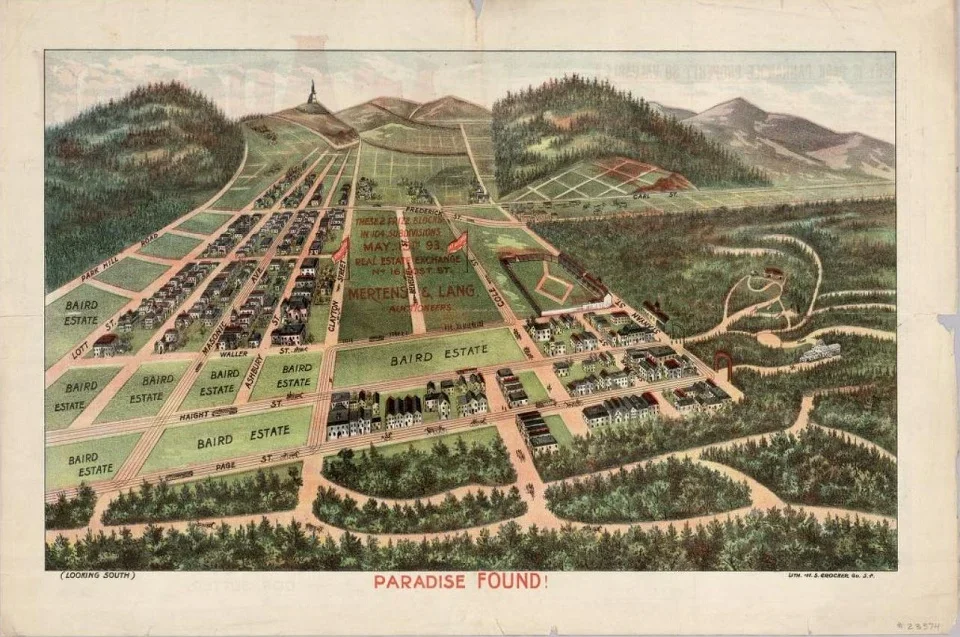
The locked-up Baird lands shaped the whole district. An 1893 real-estate lithograph titled Paradise Found! — printed to promote an auction of nearby blocks — captures the moment two years before the Chutes arrived: a bird’s-eye view looking south across the future Haight-Ashbury, parcel after parcel marked simply “Baird Estate,” the very ground the amusement park would soon occupy.
Opening Day: November 2, 1895
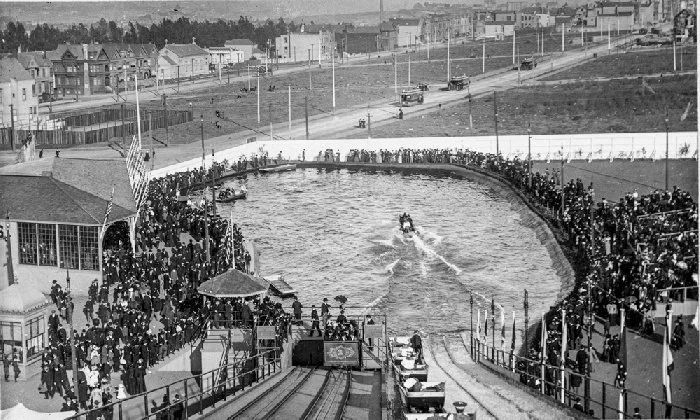
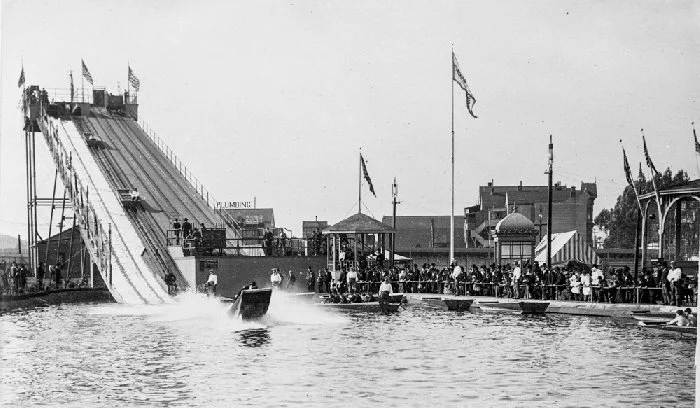
“Shoot the Chutes” opened on November 2, 1895. The San Francisco Chronicle the following morning ran a report headlined “They Shot the Chutes,” describing throngs packing the boats at the top of a 70-foot tower to take the 300-foot ride down to the pool below. Two tracks ran carts continuously to the summit; boats launched every fifteen seconds. They hit the lake at speeds up to sixty miles per hour. The front end shot skyward on contact, and occasionally a gondola flipped entirely. None of this was a design flaw.
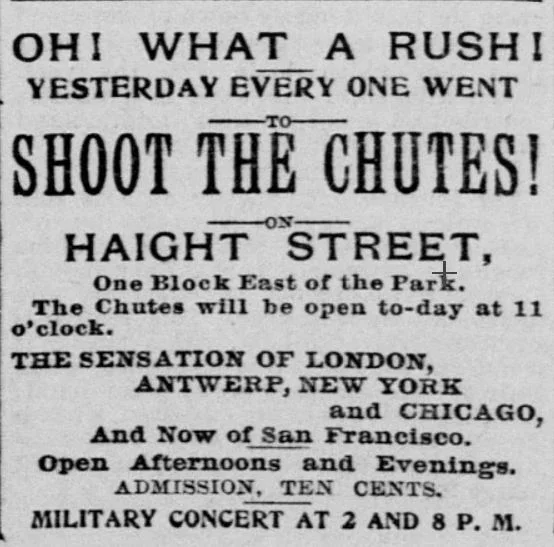
Admission was ten cents for adults, five for children. The morning after, the San Francisco Call trumpeted the crush of opening-day visitors in a full-column advertisement.
The Park Expands: Scenic Railway, Casino, Theatre (1896–1897)
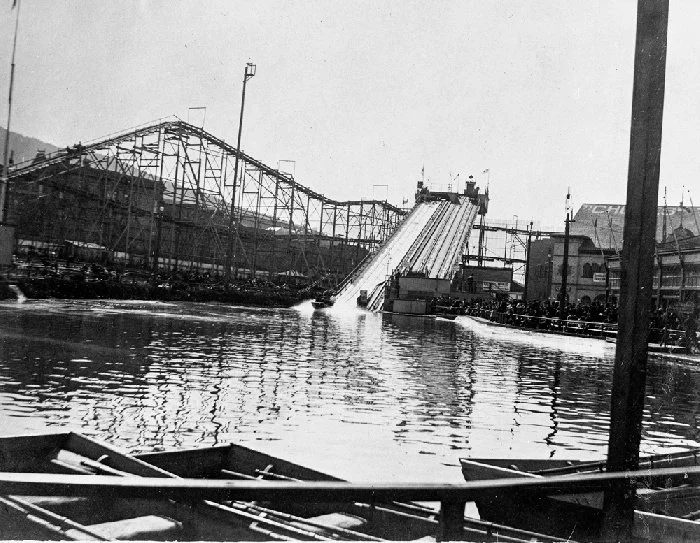
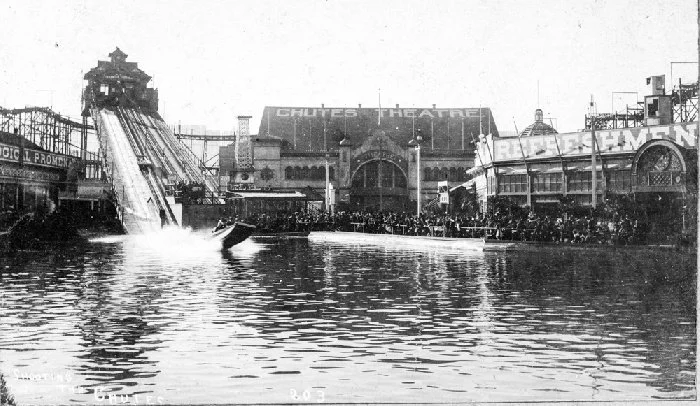
The following summer brought the Scenic Railway — a nearly mile-long train ride on elevated and lower tracks, ending in an 800-foot electrically lit tunnel with a painted diorama of foreign lands. A Casino building opened in 1896 hosting vaudeville and a roller skating rink. By June 27, 1897 it had been upgraded to a 3,000-seat Chutes Theatre.
The Full Pleasure Ground: Zoo, Camera Obscura, and Every Attraction
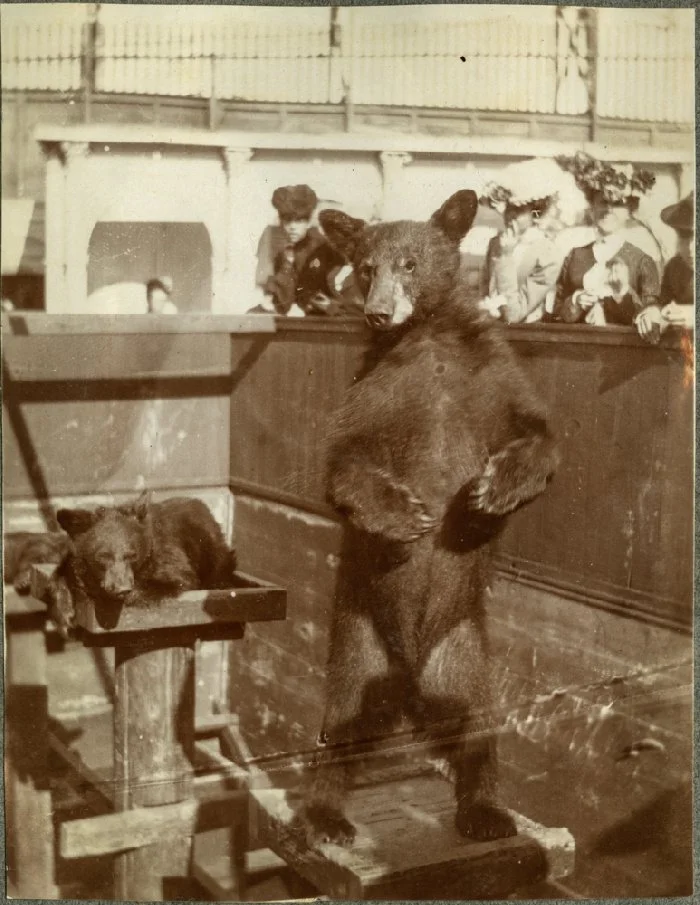
By March 1898 the park had added a full zoo. Its headliner was Wallace, billed as “the fiercest lion in America.” The collection also included a jaguar, kangaroos, wallabies, leopards, bears, a hyena that “refused to laugh,” a tiger, an alligator, and various species of monkey. The monkeys were housed in a structure specifically named the “Darwinian Temple,” where many could be touched and fed. Animals that died were stuffed and displayed in the Chutes Museum.
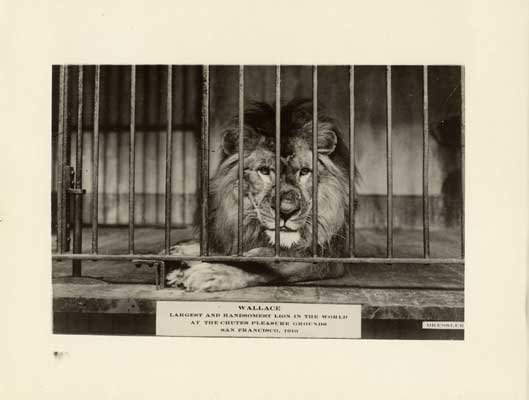
In August 1898 a Camera Obscura was installed atop the tower inside a Japanese-style structure, using a giant convex lens focused on a mirror to provide a telescopic panoramic view of the surrounding neighborhood. Additional attractions included a shooting gallery (using .22 rifles), two merry-go-rounds (including an English “Galloping Horses” with crankshaft up-and-down motion), “The Bewildering London Door Maze” (so confounding staff had to retrieve trapped visitors), the ball toss game “Dinah’s Wash Day,” a penny arcade, a restaurant, a photo gallery, and periodic balloon ascensions.
The Chutes at Night
The park operated from early afternoon into the late evening, its tower and buildings ablaze with gas and electric light against the western San Francisco night — a mountain of illumination rising from the edge of Golden Gate Park.
The Chutes at night, circa 1901 · wnp26.1487 · OpenSFHistoryWhy the Chutes Really Closed
On September 24, 1901, a judge ordered the final distribution of Baird’s million-dollar estate. The park announced it had “outgrown the premises.” As historian Angus Macfarlane, quoted in Hoodline, makes explicit:
The life of the Haight Street Chutes was limited because of the Baird estate limitations, not because it outgrew the site.
Closing day was March 16, 1902. The lake was drained. Belvedere Street was extended from Waller to Haight. The land was developed from 1902 onward. Ackerman’s operation reopened on Fulton Street on May 1, 1902, eventually moving to Fillmore Street, where it burned on May 29, 1911, killing three people.
c. 1902 — c. 1998
Part TwoThe Building After the Chutes
Building a New Block on an Emptied Lake
The clearing of the Chutes land set off rapid construction. As architectural historian Christopher VerPlanck documents for the Friends of 1800, development along Haight Street itself had been “stymied” for years because the Baird estate owned most of the frontage. Once that restriction lifted, new commercial buildings rose quickly. The Victorian building that now stands at 1601 Haight — with its large corner windows on two sides, brick and frame construction, and two-story commercial-residential form — is characteristic of the Edwardian commercial development that filled the Upper Haight in the first decade of the twentieth century.
The 1906 earthquake and fire left the Haight largely intact. The neighborhood was built on solid ground west of the major fault rupture zones, and the fires that followed did not reach this far. The Upper Haight emerged from April 1906 as one of the few parts of the city that had not burned, absorbing some of the displaced population from neighborhoods that had.
A Neighborhood Pharmacy, a Tool Shop, a Hairstylist
The specific sequence of early tenants at 1601 Haight has not been recovered from surviving city directories — those records were largely destroyed in the 1906 fire and earthquake. What the historical record preserves, cited in both SFist’s 2024 closure coverage and Hoodline’s 2014 retrospective, is a summary: the space served at various points as a pharmacy, a tool shop, and a hairstylist’s before becoming a barber shop. The order is not specified in any surviving source.
The pharmacy is the easiest to place contextually. Corner Victorian buildings in the early Haight were frequently home to drug stores — the Haight had multiple neighborhood pharmacies in the early twentieth century, serving the dense residential population of a streetcar suburb. The building’s ground floor likely served a quiet succession of practical trades through the 1910s, 1920s, and into the Depression years.
Depression, War, and a Changing Street
The Depression hit the Haight hard. As VerPlanck documents for the Friends of 1800, “by 1939, absentee landlords owned most of the dwellings in the Haight, and fifteen percent were determined to be substandard by the Planning Department.” World War II brought a different kind of pressure: the number of dwelling units in the neighborhood nearly doubled between 1939 and 1945, from 4,750 to 8,770, as single-family homes were subdivided for war workers. In the years after the war, the Haight became one of the few San Francisco neighborhoods where African American families could find housing, and Black-owned businesses established themselves on Haight Street. As Woody LaBounty writes for SF Heritage, the neighborhood became “a mosaic of races and nationalities unique in the City.”
The Summer of Love and the Long Hangover
By the mid-1960s the Haight had become the center of a worldwide cultural phenomenon. The Summer of Love in 1967 drew an estimated 100,000 young people. But from a commercial vacancy rate of 4 percent in 1965, Haight Street was at 35 percent in 1971 — a reporter counted 24 boarded-up windows on just three blocks. As Steve Heilig writes in the Haight Street Voice from the vantage of someone who arrived in the early 1970s, the street was “rundown, boarded up, and even threatening.” Whatever business operated at 1601 Haight through those years survived in the context of a street that had seen the world descend on it, and then the world leave.
Delaney’s Barber Shop: 1601 Haight, Confirmed 1974
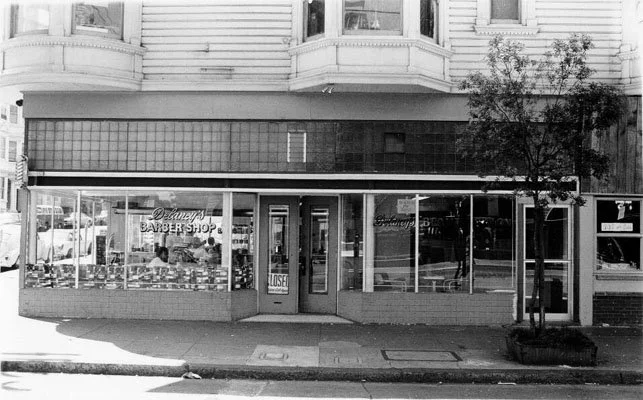
The last documented pre-bar tenant at 1601 Haight is the most precisely evidenced: Delaney’s Barber Shop. A San Francisco Public Library photograph (catalog number AAB-8823), taken in 1974 and reproduced in Hoodline’s 2014 history, shows the building exterior with Delaney’s signage clearly visible. It is the only surviving visual record of 1601 Haight between the departure of the Chutes in 1902 and the arrival of the bars in the 1980s. The photograph captures the building exactly as the room is recognizable today: the same Victorian commercial facade, the same generous windows, the same corner position. A “Closed” sign hangs on the door.
By 1979, when the building’s owner William Sapatis applied to the ABC for a liquor license, the space was described as a “former barber shop.” SF Heritage’s Woody LaBounty notes that in 1980 there were already 33 bars and liquor stores within 1,000 feet of Haight and Clayton. One more was coming.
c. 1980 — c. 1995
Part ThreeAchilles Heel Victorian Pub
William Sapatis and the Straight Bar
By the late 1970s, the Haight had transformed: a neighborhood of diverse communities, multiple gay bars, and a street identity forged in the counterculture. Into this landscape stepped William Sapatis, the lawyer and landlord who owned 1601 Haight. In 1979 and 1980 he applied to the California ABC for a liquor license to convert the former barber shop into a bar — explicitly, a straight bar. He was the subject of a January 16, 1980 San Francisco Examiner article headlined “The Straights Want Rights: Their Own Bar.” As Hoodline documented, photographed with a pipe and a “virile mustache,” he said of his critics:
They don’t like me… and they can go to hell.
The existing bars, he argued, were either “too gay” or “sleazy” for general use. The ABC initially denied the application — 33 bars and liquor stores in a 1,000-foot radius was enough. Sapatis appealed twice. The license was eventually granted. The legal record describes the proposed premises in terms that describe the room today: “Located in a renovated Victorian building with large windows on two sides, it was to be a ‘fern’ bar, a now-common type of saloon marked by an ambience of ferns and other plants, the interior of which is visible from the outside.” The ferns never materialized. What remained was the brass-and-brocade decor Hoodline later described as “faintly fern bar, without the ferns.”
The license was granted after two appeals, in 1980 or 1981. Achilles Heel Victorian Pub opened sometime thereafter — the space could not have operated as a bar before the license was finally secured.
The Bar in Operation
Achilles Heel operated at 1601 Haight through approximately the mid-1990s. Relatively little has been written about its daily life. The Haight Street Voice, in a December 2025 memoir of the neighborhood by Steve Heilig — who explicitly brackets the bar as “Now the Green Heron!” for his 2025 readers — recalled: “I retailed some pot from the back room at Achilles Heel to make ends meet.” This was the Haight of the early 1980s: coming back, but rough-edged.
The Vacancy, Then Hobson’s
According to a 2010 San Francisco Examiner interview with longtime Hobson’s Choice bartender Ellis Clayton — cited in Hoodline — “the space remained Achilles Heel until the mid-1990s, then stood vacant for a few years before Hobson’s took over.” This three-part sequence — Achilles Heel to mid-1990s, vacancy, then Hobson’s — is the most credible account of the transition. Clayton was a longtime Hobson’s bartender with direct knowledge of the bar’s history. His mid-1990s closing date for Achilles Heel and his explicit mention of a vacancy gap together place Hobson’s opening squarely in the late 1990s, consistent with the BBB business registration of August 1, 1998.
1998 — 2024
Part FourHobson’s Choice
The Victorian Punch House
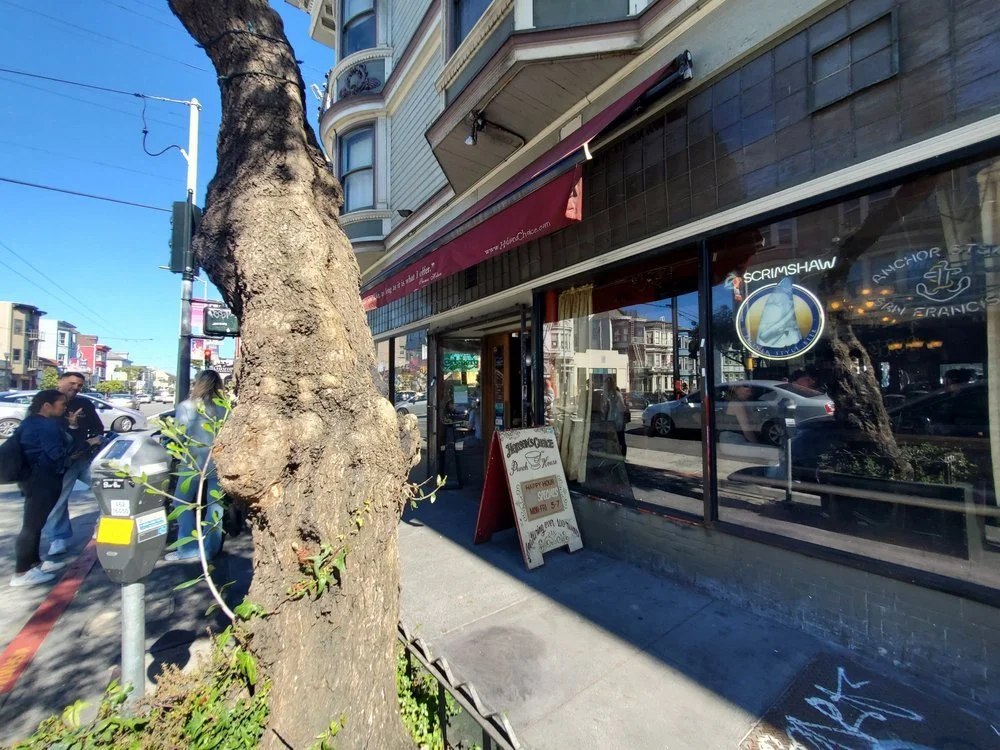
Hobson’s Choice opened at 1601 Haight on August 1, 1998, committing entirely to a concept: rum. The BBB business registration confirms that date precisely; Broke-Ass Stuart’s description of the bar “closing down after 26 years” in 2024 corroborates it exactly. According to the bar’s own description, the Victorian-era decor was a deliberate reflection of rum’s prominence in the Victorian period, and the name drew on Thomas Hobson — the 17th-century English stable owner who gave customers no real choice but to take what was offered. Three house punches anchored the menu: the House punch, the Victorian, and the Gogo. The bar claimed the largest rum selection of any bar in the United States — over 100 varieties.
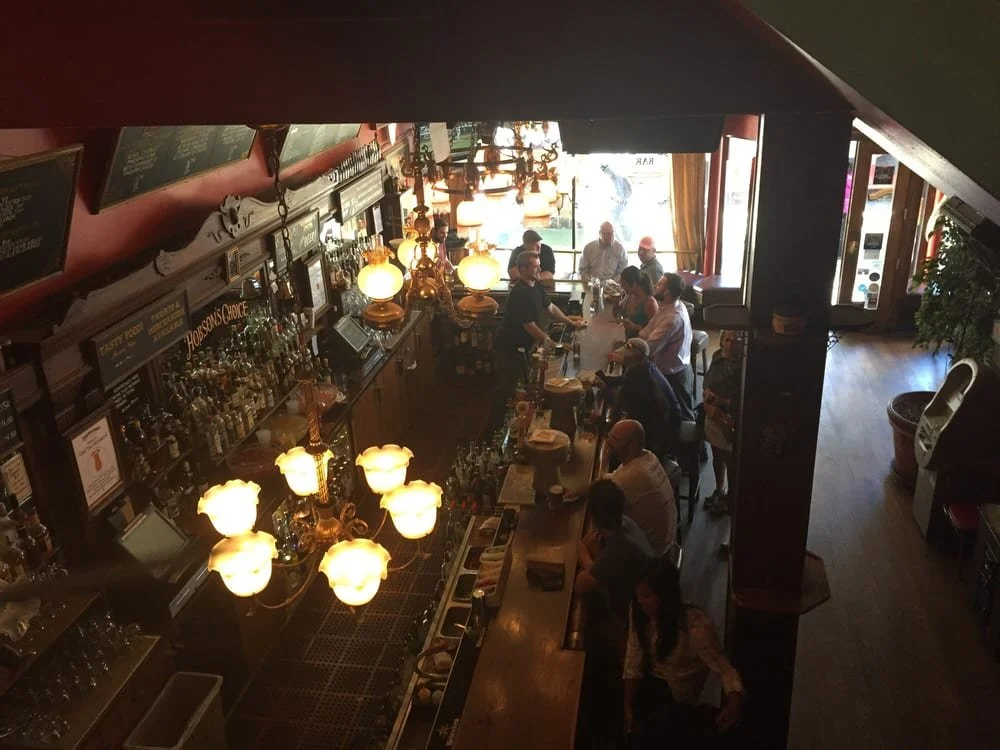
As the San Francisco Examiner reported in 2010, “before San Francisco had specialty bars, it had Hobson’s Choice, one of the first rum bars to ever land in San Francisco.” Bartender Ellis Clayton described the Wednesday ritual: a sign bearing only a question mark, meaning the bartender chose your drink. “It’s whatever I give you.”
The room was perfectly suited to it. The large corner windows on two sides — the same windows present in Sapatis’s 1980 ABC application, the same windows visible in the 1974 Delaney’s photograph, the same windows that look out from the Green Heron today — made the bar visible from the street and placed drinkers in a kind of theater: watching Haight Street’s endless human procession while being watched in turn. Dogs were welcome. Sundays brought a make-your-own Bloody Mary bar. There was an upstairs lounge. It was the kind of bar you could wander into alone and never feel out of place.
Chris Dickerson became co-owner in 2002, four years after the bar opened. He shaped Hobson’s into something that mattered beyond its drinks. Hobson’s Choice was the first San Francisco bar at which Broke-Ass Stuart Schuffman ever became a regular. He was in the city in summer 2002 for an internship at Bill Graham Presents, living at Haight and Central, and a friend named Liz would take him to happy hour there. “I was really broke so they’d often buy me a drink or two and let me eat off their nachos,” he later wrote. “People I met there led me to some of the folks I’m still good friends with to this day, including the epic music photographer Victoria Smith.”
The Pandemic and Closure
The COVID-19 pandemic closed the bar for 351 days. At its 2021 reopening under California’s Red Tier, Dickerson told KPIX/CBS San Francisco: “It’s been 351 days since I’ve poured a drink and had a sale. So today is a very big day.” The neighborhood that reopened into was changed — service industry workers who had lived nearby had been priced out and did not return.
On April 5, 2024, Broke-Ass Stuart published a deep-dive profile of Hobson’s Choice for SFGate in which Dickerson said: “A lot of service industry people lived in the neighborhood. So they’d get off work at a restaurant at 10-ish, 11-ish, and come back to the neighborhood and hang out until close. They’re no longer here. I don’t feel like I’m alone, but it still sucks.” On May 6, 2024, SFist reported the permanent closure, first broken by Broke-Ass Stuart. The landlord had reduced the rent — this was not predatory landlordism but a neighborhood that had changed beneath the people who sustained it. The closure also meant the loss of another Black-owned San Francisco business. “I may be the only one left in the Upper Haight,” Dickerson had said. He was right. After 26 years, Hobson’s served its last drinks in summer 2024.
2025 — Present
Part FiveThe Green Heron
New Hands, Familiar Room
In July 2025, Eater SF reported that four co-owners — Ben Sapone, Brent Piercy, Conner Frederick, and Wes Wakeford — were taking over the space. The team behind The Red Tail, an Inner Sunset beer and wine bar that had recently opened a second location in the former Waystone space in the Warfield Building on mid-Market, the Green Heron would be their first venue with a full liquor license. Co-owner Wes Wakeford: “I know it’s a change for people in the [Haight] area. But I think a lot of people are eager to be in that space again. It’s so prime being one block from Haight-Ashbury. It’s extreme people-watching.”
The Renovation and Space
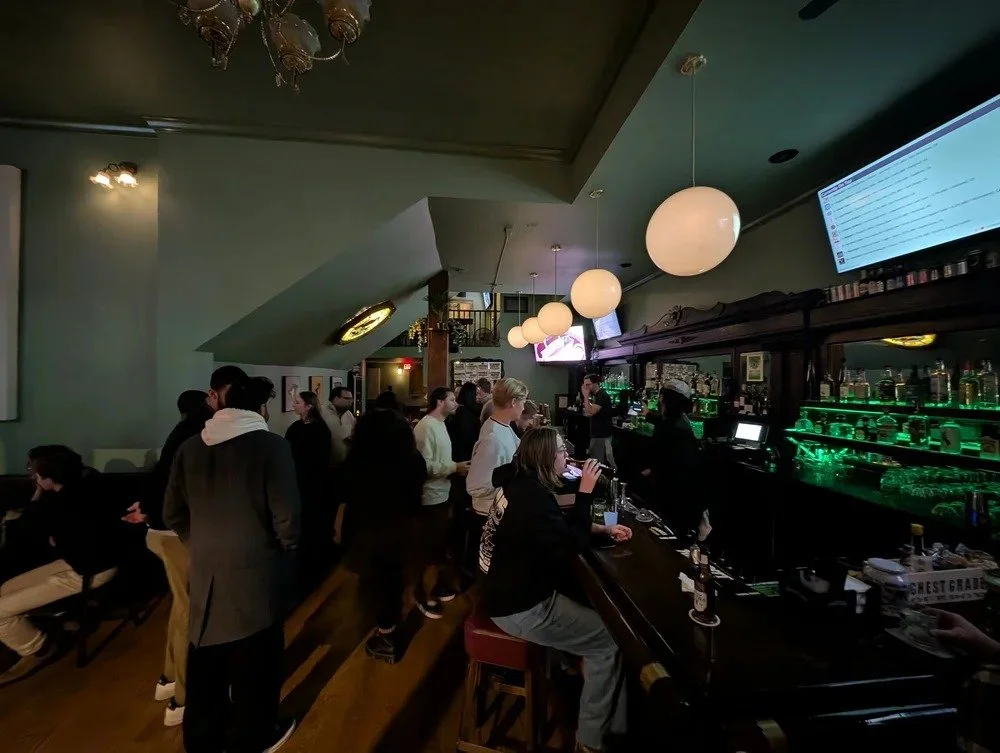
The team took over the space in 2025 and spent months renovating before opening on November 6, 2025 — nearly 130 years to the day after the Chutes first opened on this corner in 1895. As their website describes: “New floors, new tables, a stained glass installation of the bar’s namesake bird, and a fresh take on the space.” Local artists’ work was hung on the walls. Flat-screen TVs were added throughout for game days. The large corner windows on two sides — the spatial inheritance running from Delaney’s barber shop through Achilles Heel and Hobson’s Choice into the present — were preserved. The space has three distinct areas: a main room with floor-to-ceiling corner windows at one of the best people-watching intersections in San Francisco; an upstairs lounge with candlelit tables, a comfortable couch, and a view down into the bar below; and a back room for private separation. As the Our Story page puts it: “Bringing fresh energy to the historic Haight and Clayton corner once home to Hobson’s Choice.”
The Concept, Hours, and Reception
The menu is grounded and without pretension: Old Fashioneds, martinis, 90-plus beer-and-shot combinations, local craft beers from Laughing Monk and Humble Sea alongside Miller Lites and Modelos. Rum drinks and punch-inspired beverages appear as a deliberate homage to Hobson’s Choice. As the SF Examiner noted: “While it’s not a dive, The Green Heron will mimic Hobson’s laid-back vibe and offer something for everyone.” Happy hour Monday–Friday 10am to 5pm. Weekly trivia, bingo, and regular DJ nights. Current hours: Sunday–Tuesday 10am to midnight; Wednesday–Saturday 10am to 2am.
Eater SF called it “an unfussy, homey bar.” The Infatuation listed it as a cocktail bar worth knowing in the Haight. Community reviewers: “A much needed revamp of Hobson’s Choice. It still feels cozy like the old bar with some updates.” Come as you are. Stay as long as you like.
Coda
Wallace the lion was fed here. Boats launched from this corner every fifteen seconds and hit the lake at sixty miles an hour. A Camera Obscura showed this neighborhood to itself from a Japanese pavilion at the top of a 70-foot tower. Monkeys were available to touch in the Darwinian Temple. The lake was drained. Belvedere Street was extended. A pharmacist filled prescriptions here. A tool shop sold its wares. A hairstylist worked these windows. A barber named Delaney did the same for decades, a “Closed” sign on his door in 1974. A lawyer fought the city twice for the right to decide who drank here. Then, after the fern bar without ferns closed in the mid-1990s and the room sat empty for a few years, a rum punch master opened on August 1, 1998, and spent 26 years ladling House punch and Victorian punch and Gogo punch for the changing neighborhood outside his windows. Then the room went dark.
The Green Heron opened the windows again. The stained glass bird is not decorative — it is a claim. This corner has been generating life for 130 years.
Come as you are.
Stay as long as you like.
Timeline
1601 Haight Street at Clayton — a complete chronology of every documented use of this corner, from the amusement park that made it famous to the bar that calls it home today.
- 1895–1902The Haight Street Chutes amusement park. Clayton Street formed the northern boundary of the park; the 70-foot water chute tower, man-made lake, Scenic Railway, 3,000-seat Chutes Theatre, zoo, and Camera Obscura were all built here.
- Nov 2, 1895Opening day: “Shoot the Chutes” opens. Boats launched every 15 seconds, hitting the lake at up to 60 mph.
- 1896Scenic Railway (nearly a mile long) added; Casino building opens with vaudeville and roller skating rink.
- Jun 27, 1897Casino upgraded to the 3,000-seat Chutes Theatre.
- Mar 1898Zoo opens. Headliner: Wallace the lion. Also includes jaguars, kangaroos, bears, a hyena, an alligator, monkeys in the “Darwinian Temple.”
- Aug 1898Camera Obscura installed atop the tower in a Japanese-style pavilion.
- Sep 24, 1901Judge orders distribution of Baird estate; lease cannot be renewed.
- Mar 16, 1902Chutes closes. Lake drained; Belvedere St extended from Waller to Haight.
- May 1, 1902Fulton Street Chutes opens (Ackerman’s successor park).
- c. 1903–1910Building constructed at 1601 Haight as part of the post-Chutes commercial development wave. Victorian/Edwardian corner building with large windows on two sides.
- c. 1910–1960sGround floor serves as neighborhood pharmacy, tool shop, and hairstylist’s at various points. Exact sequence and dates not recovered from surviving records.
- Apr 1906Earthquake and fire devastate San Francisco. The Upper Haight is largely spared.
- May 29, 1911Fillmore Street Chutes burns in catastrophic fire, killing three. The ride that began on this corner ends in ash eleven blocks away.
- 1967Summer of Love. Haight St commercial vacancy rises from 4% (1965) to 35% (1971).
- 1974Delaney’s Barber Shop confirmed at 1601 Haight by SFPL photograph (catalog AAB-8823).
- 1979–1980Owner William Sapatis applies twice to California ABC for liquor license. Both initially denied; license eventually granted after two appeals.
- c. 1980–1981Achilles Heel Victorian Pub opens at 1601 Haight — Sapatis’s “straight bar” in a neighborhood with a growing Black and gay identity.
- c. 1993–1995Achilles Heel closes. Per Hobson’s Choice bartender Ellis Clayton (2010 interview): “the space remained Achilles Heel until the mid-1990s.”
- c. 1995–1998Space stands vacant. Per Ellis Clayton: “then stood vacant for a few years before Hobson’s took over.”
- Aug 1, 1998Hobson’s Choice opens. Date confirmed by BBB business registration (Business Started: 8/1/1998). Stuart’s “26 years” and Clayton’s timeline both corroborate this date.
- 2002Chris Dickerson becomes co-owner, four years after opening.
- 2020–2021COVID-19 pandemic closes the bar for 351 days. Reopens under California’s Red Tier.
- Apr 5, 2024Broke-Ass Stuart publishes SFGate profile of Hobson’s Choice; Dickerson describes changed neighborhood foot traffic.
- May 6, 2024Permanent closure announced. After 26 years, Hobson’s serves its last drinks in summer 2024.
- Jul 7, 2025Green Heron announced: Ben Sapone, Brent Piercy, Conner Frederick, Wes Wakeford (the Red Tail team) take over the space.
- Nov 6, 2025The Green Heron opens — nearly 130 years to the day after the Chutes first opened on this corner.
Sources & Further Reading
The Haight Street Chutes
Arnold Woods / OpenSFHistory (Jul 12, 2020) — Haight Chutes: A Closer Look
Arnold Woods / OpenSFHistory (Jul 19, 2020) — Fulton Chutes: A Closer Look
Hoodline / Amanda Gonzalez (Jun 12, 2016) — When “Shooting The Chutes” Was The Thing To Do
FoundSF — Haight Chutes (Arnold Woods, republished)
Wikipedia — The Chutes of San Francisco
David Rumsey Map Collection — “Paradise Found!” lithograph (Mertens & Lang, 1893)
California Digital Newspaper Collection — San Francisco Call advertisements, Nov. 1895
Neighborhood History — Gap Years Context
Christopher VerPlanck / Friends of 1800 — Architecture & Social Structure of the Haight (Part 1)
Christopher VerPlanck / Friends of 1800 — (Part 2)
Woody LaBounty / SF Heritage (Aug 30, 2022) — Haight Street Renaissance
Steve Heilig / Haight Street Voice (Dec 2025) — Through the Decades: The Haight Stays Great
SFPL Historical Photograph Collection — AAB-8823: Delaney’s Barber Shop, 1974
Achilles Heel — Primary Sources
Hoodline / Camden Avery (Sep 13, 2014) — History of the Upper Haight: Achilles Heel, The Fern Bar
ABC Appeal Record (via Hoodline) — Legal record of Sapatis ABC appeal
Hobson’s Choice
BBB Business Profile — Business Started: 8/1/1998 (primary date source)
SF Examiner (2010) — Mixologist: Fall Punch-Drunk in Love with Hobson’s Choice
CBS SF / KPIX (2021) — SF Bar Owners Cautiously Optimistic About Red Tier
Broke-Ass Stuart (May 6, 2024) — Hobson’s Choice Is Closing Down (“26 years”)
Yelp (674 reviews) — Hobson’s Choice San Francisco
The Green Heron
Official website — greenheronsf.com
The Space — greenheronsf.com/the-space
Our Story — greenheronsf.com/our-story
SFist (Jul 7, 2025) — Hobson’s Choice to Be Resurrected as The Green Heron
WhatNow SF (Jul 2025) — Team Behind The Red Tail Debuting Shot Bar in Upper Haight
SF Examiner (Oct 2025) — SF Restaurants Guide: 7 New Eateries, Bars
Historical Chutes photographs from the OpenSFHistory / Western Neighborhoods Project archive (opensfhistory.org), courtesy of private collectors. Delaney’s Barber Shop photograph courtesy San Francisco Public Library Historical Photograph Collection (AAB-8823). Note: SFist’s 2024 headline description of Hobson’s Choice as “36-year-old” and its “1988” opening date are errors; the correct opening date is August 1, 1998, confirmed by BBB registration and Broke-Ass Stuart’s contemporaneous reporting. Research compiled June 2026. Prepared for The Green Heron, 1601 Haight Street, San Francisco, CA 94117.